

Article Meta
There exists a curious intersection in contemporary fashion where Eastern restraint meets Western structure, where the Japanese concept of ma (negative space) encounters the European obsession with tailoring precision. This collision has produced some of the most intellectually rigorous fashion of the past 50 years—clothing that operates as philosophy made wearable.
To understand modern minimalism, you must understand this fusion. You must know Yohji Yamamoto and Jil Sander not as competitors but as conversationalists across continents. You must see layering not as styling technique but as a design language—one that communicates through what is absent as much as what is present.
This is that story.
The Philosophy of Absence: Understanding Japanese Minimalism
Japanese aesthetics operate on principles fundamentally different from Western traditions. Where Western design asks “What can I add?”, Japanese design asks “What can I remove?”
This philosophy—rooted in Zen Buddhism, Shintoism, and centuries of refined artistic practice—manifests in several core principles:
Ma (負): The Power of Emptiness
Ma translates inadequately as “negative space” or “void.” More precisely, it refers to the intentional use of emptiness as a design element with equal importance to form itself. A room is not defined by its furniture but by the space around it. A painting gains power through what remains unpainted.
In fashion, ma means understanding that the space between garments is as meaningful as the garments themselves. A loose sleeve creates ma through volume. A sheer fabric creates ma through transparency. Silence in design creates visual rest.
Wabi-Sabi: Beauty in Impermanence
Wabi-sabi celebrates imperfection, impermanence, and the patina of age. A ceramic bowl with an irregular glaze. Linen that wrinkles. Fabric that fades. Rather than viewing aging as degradation, wabi-sabi recognizes it as deepening—a garment becoming more beautiful through use.
This philosophy directly opposes fast fashion’s premise. It asks: How will this garment age? Will it improve? Will it tell a story through its wear?
Kanso: Simplicity Without Emptiness
Kanso means simplicity, but not minimalism in the reductive sense. Rather, it means distilling something to its essential nature—removing the extraneous while preserving the profound. A linen shirt with a single visible seam. A coat of pure color with no pattern. Simplicity that suggests rather than shouts.
These principles—ma, wabi-sabi, kanso—form the philosophical substrate of Japanese fashion minimalism. A designer working in this tradition isn’t simply removing elements. They’re engaging in a deliberate act of subtraction, each omission pregnant with meaning.
Yohji Yamamoto: The Philosopher-Designer
To understand how Japanese philosophy translated into contemporary fashion, you must study Yohji Yamamoto.
Yamamoto, born in Tokyo in 1943, emerged in the 1980s with collections that fundamentally challenged Western notions of beauty and desirability. Where Paris was obsessed with body-conforming silhouettes and decorative excess, Yamamoto proposed something radical: clothing that concealed the body, that embraced volume and asymmetry, that prioritized the garment’s internal logic over the wearer’s physique.
His early collections featured:
- Oversized silhouettes that obscured body shape
- Monochromatic color palettes (predominantly black)
- Unexpected proportions (long sleeves on short-sleeve garments, asymmetrical hems)
- Visible seams and construction details treated as design elements
- Negative space treated as actively as positive form
“I think tailoring is not about fitting the body,” Yamamoto has said. “It’s about creating a new body—a garment body that has its own life, its own geometry.”
This statement encapsulates the Japanese approach. The garment is not a second skin; it’s a separate entity that the body inhabits. The relationship between body and garment is negotiated through space and proportion, not through clinging conformity.
Yamamoto’s influence cannot be overstated. He demonstrated that fashion could be intellectually rigorous, philosophically grounded, and commercially viable simultaneously. He proved that minimalism wasn’t about austerity but about depth—that removing ornament revealed architecture, that silence revealed meaning.
His legacy persists in contemporary designers like Yohji Yamamoto (his own brand, still operating), as well as in the DNA of designers influenced by his philosophy: Rei Kawakubo at Comme des Garçons, Issey Miyake, and countless others exploring the intersection of Japanese aesthetics and fashion.
European Minimalism: The Architecture of Tailoring
While Japanese minimalism emerged from philosophical and spiritual traditions, European minimalism developed from a different source: the rigorous pursuit of tailoring perfection.
The European minimal movement—particularly associated with designers like Jil Sander, Helmut Lang, and Ann Demeulemeester—approached simplicity through the lens of craftsmanship and structure. If you remove decoration, every seam becomes visible. Every proportion becomes audible. Excellence becomes inescapable.
Jil Sander: The Mathematician of Fashion
Jil Sander, a German designer who built her empire on radical simplification, approached minimalism as a problem of perfection. Her early 1990s collections featured:
- Impeccable tailoring with invisible seams
- Neutral color palettes (whites, creams, grays, blacks)
- Proportions refined through obsessive iteration
- Fabrics chosen for their inherent properties rather than applied decoration
- A belief that one perfect white shirt was worth more than fifty mediocre designs
“I design for women who want to look like themselves, only better,” Sander famously said.
This statement reveals the European approach: minimalism as clarity, as a vehicle for authenticity rather than concealment. Where Yamamoto’s oversized silhouettes create distance between body and garment, Sander’s precisely tailored pieces create intimacy—a second skin of such perfection that it becomes invisible.
Sander’s influence revolutionized luxury fashion. She demonstrated that you could build a global brand on the principle of refinement, that scarcity and simplicity could command premium pricing, that less could genuinely be more.
Helmut Lang: The Conceptual Engineer
Austrian designer Helmut Lang took European minimalism in a different direction: toward conceptual innovation. Where Sander pursued tailoring perfection, Lang pursued structural innovation—finding new ways to construct garments, new proportions, new relationships between body and fabric.
His collections featured:
- Unconventional seaming and construction methods
- Experimental proportions that preceded broader trends
- Integration of technology and innovation
- Removal of traditional tailoring flourishes in favor of architectural precision
- Garments that prioritized structure over comfort
Lang’s legacy is perhaps less commercially dominant than Sander’s or Yamamoto’s, but his influence on contemporary fashion is profound. He proved that minimalism could be experimental, that simplicity could house complexity, that restraint could coexist with innovation.
The Convergence: Where East Meets West
The fascinating moment in contemporary minimalist fashion is the convergence of these two traditions. Japanese designers began engaging with Western tailoring precision. European designers began exploring Eastern aesthetics of void and suggestion.
This fusion produced some of the most intellectually coherent fashion of recent decades.
Consider the work of contemporary designers operating in this intersection:
Lemaire (French, founded 2005) — Combines Japanese aesthetic restraint with French tailoring tradition. Collections feature impeccable construction (European) paired with oversized proportions and emphasis on negative space (Japanese). Price: $1,200-4,000 per garment.
Nendo Studio (Japanese) — Conceptual design studio that approaches fashion through Japanese spatial philosophy while employing Western construction methods. Garments are technically flawless (European) while embracing void and suggestion (Japanese).
Xander Zhou (Chinese-born, based Berlin) — Merges Chinese philosophical concepts with German precision. Collections feature oversized silhouettes with invisible seams, combining Asian proportion philosophy with European construction excellence.
Studio Nicholson (British-Japanese collaboration) — Deliberately positions itself at the intersection of Japanese aesthetic philosophy and British tailoring tradition. Collections are designed around the principle: “What is the minimum required to communicate maximum meaning?”
These designers represent the maturation of minimalism: a global language that transcends East/West binaries, drawing from both traditions simultaneously.
The Art of Layering: A Practical Philosophy
Understanding Japanese and European minimalism becomes most tangible when applied to the practice of layering—the strategic combination of simple pieces to create visual and textural complexity.
True layering is not about wearing many clothes. It’s about creating depth through the relationship between pieces. Each layer should be visible, intentional, and meaningful.
Principle 1: Proportion Through Layering
Japanese minimalism uses layering to create proportion and volume. Rather than a fitted garment conforming to the body, layering allows you to create a silhouette through the interaction of multiple loose pieces.
Practical approach:
- Oversized linen shirt (untucked)
- Lightweight wool sweater (worn open, sleeves rolled)
- Unstructured blazer (slightly oversized)
The individual pieces are simple. But their interaction creates complexity and visual interest through proportion and the ma between them.
Principle 2: Texture Through Simplicity
European minimalism uses layering to create tactile interest while maintaining color restraint.
Practical approach:
- White cotton shirt (fine weave)
- Cream wool knit (loose gauge)
- Charcoal linen trousers
All neutral colors. All simple pieces. But the textural variation—smooth cotton against loose-knit wool against linen’s characteristic slub—creates visual complexity through material difference.
Principle 3: Negative Space as Active Design
Both traditions use layering to create intentional negative space—gaps where skin or undergarments show through.
Practical approach:
- Oversized white shirt (worn unbuttoned)
- Fitted black turtleneck underneath (visible through opening)
- Loose charcoal cardigan (worn open, sleeves pushed up)
The “empty” space created by the unbuttoned shirt becomes an active design element, framing the layers beneath.
Principle 4: Proportion Variation
Successful layering requires proportion contrast: if all pieces are loose, they collapse into formlessness. If all are fitted, they become restrictive.
Optimal approach:
- One fitted piece (creates anchor)
- One oversized piece (creates volume)
- One medium piece (creates transition)
This principle applies whether you’re layering Japanese-influenced pieces or European-influenced pieces.
Seasonal Layering: A Year-Round Practice
The beauty of minimalist layering is its adaptability across seasons. Rather than seasonal wardrobes, you’re adapting the same core pieces through strategic layering.
Spring/Summer Layering:
- Lightweight linen shirt (primary layer)
- Sheer cotton overshirt (adds dimension without weight)
- Minimal jewelry (emphasizes negative space)
- Focus: Creating visual complexity through transparency and air
Fall/Winter Layering:
- Fine wool base layer (thermal function)
- Wool sweater (texture and volume)
- Wool coat (structure and proportion)
- Focus: Creating visual complexity through texture and proportion
The core pieces remain consistent. Layering strategies shift seasonally to accommodate climate while maintaining design coherence.
Investment Pieces From Each Tradition
If you’re building a minimalist wardrobe informed by both traditions, strategic investment in key pieces creates infinite styling possibilities.
Japanese-Influenced Pieces to Invest In:
Oversized Wool Coat ($800-2,000)
- Loose proportions, perfect for layering
- Ages beautifully, develops patina
- Works across seasons through layering variation
Linen Shirt ($300-800)
- Wrinkles become design feature (wabi-sabi)
- Versatile through different layering approaches
- Improves with wear and washing
Unstructured Blazer ($600-1,500)
- Creates proportion when layered over fitted pieces
- Maintains shape without relying on structure
- Works across occasions through styling variation
European-Influenced Pieces to Invest In:
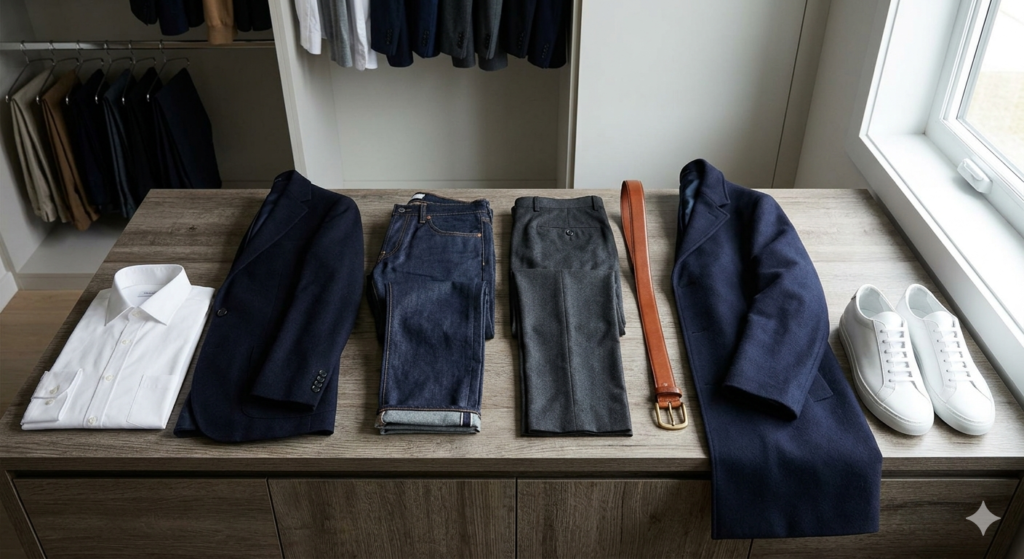
Perfect White Shirt ($200-600)
- Foundation for all minimalist layering
- Impeccable tailoring creates versatility
- Works with everything through precision fit
Tailored Trousers ($300-800)
- High-waisted for proper proportion
- Works as anchor piece in layered outfits
- Investment in construction quality ensures longevity
Fitted Turtleneck ($200-500)
- Creates texture variation in neutral palettes
- Precision fit prevents bulk in layered outfits
- Versatile across seasons and occasions
Total Investment for Minimalist Foundation: $2,500-7,000 for 7-8 pieces that create infinite combinations.
The Philosophy of Less: Why This Matters
Understanding minimalist philosophy—whether Japanese or European—offers something more valuable than style tips. It offers a framework for thinking about consumption itself.
Both traditions ask fundamental questions:
- What is essential?
- What can be removed without diminishing meaning?
- How does simplicity create possibility rather than limitation?
In a fashion industry predicated on novelty and excess, these questions are radical. They suggest that the point of fashion isn’t accumulation but curation, not fashion weeks but longevity, not trends but timelessness.
A woman with 200 clothes she constantly rewears is engaging in fast fashion psychology regardless of price point. A woman with 30 carefully chosen pieces she layers strategically and wears for decades is engaging in genuine luxury—not because the pieces are expensive, but because they’re intentional.
This is where Japanese and European minimalism converge most profoundly: in the belief that intention transforms consumption into something meaningful. That thoughtfulness elevates utility into art.
Building Your Minimalist Practice
If this philosophy resonates, how do you translate it into practice?
Start with one concept: Choose either Japanese-influenced proportion experimentation or European-influenced tailoring perfection. Master one before attempting synthesis.
Invest strategically: Build around 3-4 core pieces rather than accumulating broadly. Each new piece should create new combinations with existing pieces.
Embrace impermanence: Allow garments to age. Wrinkles in linen become character. Fading in black cotton reveals history. This is not degradation; this is beauty deepening.
Think in seasons: Plan layering around your climate. How will you vary the same core pieces across four seasons? This exercise reveals true versatility.
Resist newness: The strongest minimalist wardrobes are those that resist trend. If you’re constantly replacing pieces, you’re not minimizing—you’re chasing. True minimalism means wearing the same garments for years and finding endless variations through layering and proportion play.
Conclusion: The Luxury of Restraint
Walking through a contemporary boutique selling $800 Jil Sander shirts and $1,200 Lemaire sweaters, one could be forgiven for thinking minimalism is simply expensive austerity—luxury stripped of ornamentation.
But that’s a misunderstanding.
Minimalism, both Japanese and European, isn’t about deprivation. It’s about precision. It’s about the belief that one perfect object is worth more than a thousand mediocre ones. That simplicity requires more discipline than complexity. That what you remove communicates as powerfully as what you add.
This is where fashion becomes philosophy. Where getting dressed becomes a practice rather than a consumption event. Where a capsule wardrobe of 30 pieces reveals more about your aesthetic sensibility than a closet of 300.
The art of layering—in all its simplicity—is actually the art of clarity. It’s the practice of asking, with each garment: Does this serve? Does this speak? Does this belong?
In answering honestly, you build not a wardrobe, but a language. And in wearing that language daily, you’re engaging in one of fashion’s most radical acts: the refusal to be anything other than intentionally, minimally, beautifully yourself.