

Article
On Monday, May 4th, approximately 400 guests climbed the steps of the Metropolitan Museum of Art wearing garments whose combined production cost likely exceeded $50 million. Individual tickets cost $100,000. Tables cost $350,000. The evening raised a record $42 million for the Costume Institute.
These are extraordinary numbers. But they’re the visible numbers—the ones reported, discussed, and debated. The invisible numbers are far more interesting.
What does it actually cost to create a Met Gala dress? Not the ticket price. Not the table sponsorship. The dress itself—from the first sketch to the final stitch. The fabric sourcing. The atelier hours. The fittings. The styling team. The security for transporting a garment worth more than most apartments. The insurance.
The answer reveals an economy that operates on entirely different principles from normal commerce. An economy where a $500,000 investment in a dress worn for four hours generates $50 million in media value. Where the product isn’t the garment—it’s the photograph.
Phase 1: The Commission (Months 6-8 Before the Gala)
The Met Gala dress process begins six to eight months before the event. For major fashion houses, the commitment starts with a strategic question: Who do we dress?
This decision is not romantic. It’s calculated. Fashion houses evaluate potential celebrity partners based on three variables: social media reach (Instagram followers, engagement rate), press coverage potential (likelihood of appearing on magazine covers, news segments), and brand alignment (does this celebrity’s image match the house’s positioning?).
Once a celebrity is identified, the house extends an invitation. This invitation typically includes covering the celebrity’s $100,000 ticket, providing the custom dress (valued at $50,000-500,000+), and often contributing to styling, hair, makeup, and transportation costs.
The total investment per celebrity: $200,000-700,000, depending on the dress complexity and celebrity profile.
Why would a house spend $700,000 to dress someone for four hours? Because a single photograph of Beyoncé in your dress, shared across every fashion publication and social platform globally, generates estimated media impressions worth $20-50 million. The return on investment is extraordinary—if you choose the right celebrity.
Phase 2: Design and Concept (Months 5-6 Before)
Once the celebrity partnership is confirmed, the design process begins. For the 2026 Met Gala, with the “Fashion is Art” dress code, designers faced a specific creative challenge: how to translate art historical references into wearable garments that would photograph well on the Met’s famous staircase.
The design phase typically involves:
Creative brief development (1-2 weeks). The designer and celebrity (or their stylist) discuss vision, references, body concerns, and practical requirements. For Beyoncé and Olivier Rousteing, this conversation centered on Creole heritage and the work of artist Caroline Durieux. For Margot Robbie and Chanel, the concept was classical golden statuary.
Sketch development (2-4 weeks). The designer creates 5-15 concept sketches, each exploring different silhouettes, materials, and embellishment approaches. These sketches are reviewed by the celebrity’s team, refined, and narrowed to 2-3 finalists.
Final selection (1-2 weeks). The celebrity reviews finalists—sometimes in person, sometimes via digital presentation. A single concept is selected and approved for production.
Cost of design phase: $15,000-50,000 in designer time, studio overhead, and material sampling. This phase is almost entirely intellectual labor—the most expensive hours in the process.
Phase 3: Material Sourcing (Months 4-5 Before)
Once the design is finalized, material sourcing begins—and this is where costs accelerate dramatically.
For Kylie Jenner’s Schiaparelli dress, the house required 10,000 individual pearls. These weren’t random pearls—each was selected for size, color, and surface quality to ensure visual consistency across the garment. Sourcing 10,000 matched pearls from suppliers is a logistical challenge that can take weeks.
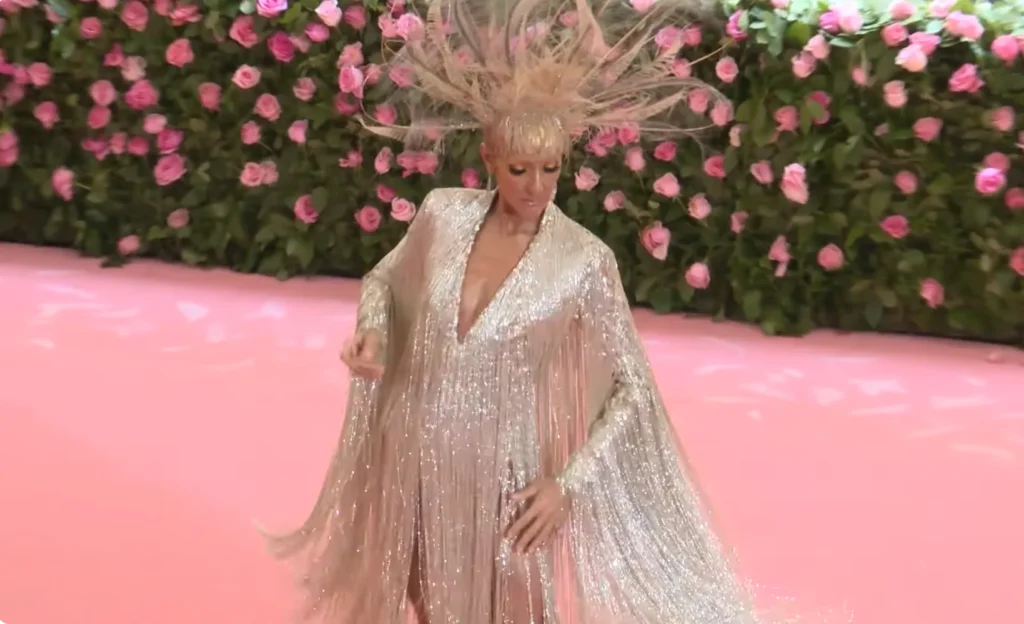
For Margot Robbie’s Chanel golden lamé, the fabric was likely woven with real metallic thread at specialty mills in France or Italy. Metallic lamé at this quality level costs $200-500 per yard. A gown requires 5-12 yards depending on silhouette. Fabric cost alone: $1,000-6,000.
For Chase Infiniti’s Thom Browne gown, 1.5 million individual sequins were required. Even at wholesale rates of $0.01-0.05 per sequin, material cost for sequins alone ranged from $15,000-75,000.
High-end Met Gala dresses frequently use:
- Silk from specific Italian or French mills ($100-400 per yard)
- Custom-dyed fabrics matched to precise Pantone specifications ($500-2,000 per custom run)
- Crystals from Swarovski or similar suppliers ($5,000-50,000 per dress)
- Pearls, beads, and semi-precious stones ($2,000-100,000 depending on quantity and quality)
- Specialty hardware (clasps, closures, structural elements): $500-5,000
Total material cost for a high-profile Met Gala dress: $10,000-150,000.
The most material-intensive dresses—those featuring extensive crystal, pearl, or sequin work—can exceed $200,000 in materials alone before a single stitch is made.
Phase 4: Construction (Months 2-4 Before)
This is where the extraordinary labor numbers emerge.
Kylie Jenner’s Schiaparelli dress: 11,000 hours of embroidery. Margot Robbie’s Chanel gown: 761 hours. Manish Malhotra’s cape: 960 hours. Chase Infiniti’s Thom Browne creation: estimated 400+ hours for sequin placement alone.
These hours represent real people performing real work. At Parisian atelier wage standards ($15-30 per hour for skilled seamstresses and embroiderers), the labor economics are:
Schiaparelli (11,000 hours):
- At $20/hour average: $220,000 in labor
- 25-30 embroiderers working simultaneously for 4-5 months
- Supervision, quality control, and project management: additional $30,000-50,000
- Total labor investment: approximately $250,000-270,000
Chanel (761 hours):
- At $25/hour average (Chanel pays premium wages): $19,025 in labor
- 3-4 seamstresses working simultaneously for 8-10 weeks
- Total labor investment: approximately $25,000-35,000
Thom Browne (1.5 million sequins):
- At 100-200 sequins per hour per artisan: 7,500-15,000 hours
- At $18/hour average: $135,000-270,000 in labor
- 15-20 artisans working simultaneously for 3-4 months
- Total labor investment: approximately $150,000-300,000
These labor costs don’t include pattern making, fabric cutting, structural engineering (for dresses requiring internal supports or architectural elements), or the multiple rounds of fitting adjustments.
Total construction cost for a high-profile Met Gala dress: $25,000-300,000 in labor alone.
Phase 5: Fittings (Weeks 8-2 Before)
A Met Gala dress typically requires 3-5 fittings before the event. Each fitting involves:
- The celebrity traveling to the atelier (or the atelier sending representatives to the celebrity’s location)
- 2-4 hours of adjustment, pinning, and evaluation
- Photography documentation of fit from multiple angles
- Post-fitting alterations (typically 20-40 hours of work per fitting)
For international celebrities, fittings may require flying the garment—and its handlers—across continents. A Chanel team traveling from Paris to Los Angeles for a fitting involves airfare, hotels, and per diem for 2-3 people.
Cost per fitting: $5,000-20,000 (including travel, labor, and adjustments)
Total fitting cost across 3-5 sessions: $15,000-100,000
Phase 6: Styling, Hair, and Makeup (Day of the Gala)
On the day of the Met Gala, the celebrity’s complete look is assembled by a team typically comprising:
- Stylist ($10,000-50,000 for Met Gala day rate, depending on profile)
- Hair stylist ($3,000-15,000)
- Makeup artist ($3,000-15,000)
- Manicurist ($500-2,000)
- Jewelry stylist (if separate from main stylist: $2,000-10,000)
- Dresser/handler ($1,000-5,000 for ensuring the garment stays perfect throughout the evening)
The styling team typically begins work 6-8 hours before the red carpet. For elaborate looks—those requiring prosthetics (Bad Bunny), theatrical elements (Madonna’s entourage), or complex jewelry coordination—preparation may begin 10-12 hours before arrival.
Total day-of styling cost: $20,000-100,000
Phase 7: Transport and Security
A Met Gala dress worth $500,000 doesn’t travel in a suitcase. High-value garments are transported in custom garment cases, often accompanied by an atelier representative who serves as both handler and security.
For international transport (Paris to New York), the dress may travel in a first-class airline seat—literally purchased for the garment. More commonly, it’s shipped via specialized art and fashion courier services that provide climate-controlled, insured transport.
Transport and insurance cost: $5,000-25,000
For the highest-value dresses (those incorporating significant diamonds, precious stones, or historical materials), security may include armed escorts and specialized insurance policies.
The Complete Cost Breakdown
Aggregating all phases, a high-profile Met Gala dress costs:
| Phase | Low Estimate | High Estimate |
|---|---|---|
| Design & concept | $15,000 | $50,000 |
| Material sourcing | $10,000 | $200,000 |
| Construction labor | $25,000 | $300,000 |
| Fittings (3-5 rounds) | $15,000 | $100,000 |
| Day-of styling team | $20,000 | $100,000 |
| Transport & security | $5,000 | $25,000 |
| Celebrity ticket ($100K) | $100,000 | $100,000 |
| Total | $190,000 | $875,000 |
The median cost for a top-20 Met Gala look is approximately $350,000-500,000, all-in.
For the most elaborate creations—Schiaparelli’s 11,000-hour pearl dress, Thom Browne’s 1.5-million-sequin gown—total investment likely exceeds $750,000.
The ROI: Why Fashion Houses Pay
These numbers seem irrational until you understand the return. The Met Gala generates more concentrated media coverage than any other fashion event—including Fashion Week.
A single Met Gala look that “wins the red carpet” generates:
Immediate media value (24 hours):
- Coverage across major publications (Vogue, Harper’s Bazaar, Elle, GQ, Vanity Fair, CNN, BBC)
- Social media impressions: 50-500 million (depending on celebrity)
- Television coverage: morning shows, entertainment news, late-night commentary
- Estimated media value for a top-5 look: $20-50 million
Extended media value (weeks-months):
- Magazine covers (June issues are typically “Met Gala recap” issues)
- Social media longevity (viral looks generate content for weeks)
- Brand association (the dress becomes synonymous with the house)
- Estimated extended media value: $10-30 million additional
Total estimated media value for a winning Met Gala look: $30-80 million.
Against a total investment of $350,000-875,000, the return is extraordinary: 40x-200x on investment. No other marketing channel in fashion delivers this ratio.
This explains why houses compete so aggressively for the right celebrity partnerships. It explains why they’re willing to invest 11,000 hours of embroidery in a dress worn for four hours. The dress isn’t the product. The photograph is.
The Sponsorship Economy: Who Actually Pays
The 2026 Met Gala revealed a significant structural shift in who funds fashion’s biggest night. Lead sponsors were Jeff Bezos and Lauren Sánchez Bezos, who contributed a reported $10 million. Amazon, Meta, OpenAI, and Snapchat all purchased tables at $350,000 each.
This represents a departure from tradition. Historically, luxury fashion houses sponsored the Met Gala—Chanel, Gucci, Louis Vuitton, Versace. The event was funded by and for the fashion industry. The 2026 edition was funded primarily by technology companies. Individual tickets climbed to $100,000, up from $75,000 in 2025. Tables rose to $350,000. The guest list increasingly included tech executives alongside traditional fashion and entertainment figures.
The economic implication is clear: the Met Gala’s value has transcended fashion. It’s now a general-purpose luxury marketing platform where any brand willing to pay $350,000 for a table gains access to the most photographed evening in American culture.
For fashion houses, this creates both opportunity and pressure. The opportunity: more money flowing into the event means higher production values, more media coverage, and greater visibility for the clothes. The pressure: competing for attention against tech-funded spectacle requires increasingly ambitious (and expensive) creative investments.
The result is an inflationary spiral. As tables get more expensive, media coverage becomes more valuable. As media coverage becomes more valuable, houses invest more in dresses. As dresses become more ambitious, construction costs rise. As construction costs rise, only the largest houses can compete at the highest level.
Independent designers—Robert Wun, Brandon Blackwood, Palomo Spain—demonstrated at the 2026 Gala that creative ambition can compete with corporate budgets. But the economic reality is stark: an independent house dressing one celebrity for $50,000-100,000 is operating at a fundamentally different scale than Chanel investing $500,000+ in a single look.
The Hidden Costs: What Nobody Reports
Beyond the visible expenses, Met Gala participation involves costs rarely discussed:
Opportunity cost. Atelier time spent on a single Met Gala dress is time not spent on commercial production. An atelier dedicating 11,000 hours to one dress over four months is diverting those hours from revenue-generating work. For a house producing 200+ commercial pieces per season, the opportunity cost of Met Gala production can exceed $500,000 in delayed commercial revenue.
Relationship management. Celebrity partnerships require ongoing investment—gifts, exclusive previews, personal shopping services, event invitations. The Met Gala dress is often the climax of a relationship maintained year-round. Annual relationship cost: $50,000-200,000 per high-profile celebrity.
Post-Gala obligations. After the event, the dress may require restoration, conservation, and archiving. Museum loans (some Met Gala dresses enter the Costume Institute’s collection) require documentation, insurance, and maintenance. Post-event cost: $5,000-50,000.
Risk management. What if the celebrity cancels? What if the dress is damaged during transport? What if the look is poorly received? Fashion houses mitigate these risks through insurance, backup options, and crisis communication planning. Risk management cost: $10,000-50,000.
The Four-Hour Window
The most remarkable aspect of Met Gala economics is the temporal compression. Months of design. Thousands of hours of construction. Hundreds of thousands of dollars invested. All compressed into approximately four hours of visibility.
The red carpet itself—the period when photographers capture the images that will circulate globally—lasts approximately 90 minutes. The dinner and program extend another 2-3 hours. After-parties add perhaps 2 more hours, though many celebrities change into different outfits.
A $500,000 dress worn for four hours costs $125,000 per hour. A dress constructed over 11,000 hours and worn for four hours represents a ratio of 2,750:1—nearly three thousand hours of construction for every hour of visibility.
By any rational economic measure, this is absurd. By the logic of luxury marketing, it’s efficient. Those four hours generate media value that would take months and millions to achieve through conventional advertising.
The Met Gala dress isn’t a garment. It’s a compression algorithm—converting thousands of hours of human skill into a single photograph that conveys more brand value than any campaign.
What This Tells Us About Luxury
The Met Gala’s economics reveal something fundamental about luxury fashion’s business model in 2026.
First, the product is increasingly secondary to the narrative. A dress that costs $500,000 to produce isn’t sold to a consumer. It’s “sold” to the media—traded for attention, coverage, and brand positioning. The garment is a means, not an end.
Second, celebrity access is now the scarcest resource in fashion marketing. Dresses can be made. Fabric can be sourced. But the right celebrity wearing the right dress at the right moment—that combination is genuinely rare. Houses compete for celebrities with the same intensity that collectors compete for art.
Third, the economics are concentrating. Only houses with sufficient capital can compete at the Met Gala’s highest level. Independent designers can participate—and 2026 showed they can succeed creatively—but the financial gap between dressing one celebrity for $50,000 and dressing five for $500,000 each is substantial.
Fourth, the boundary between fashion and tech is dissolving. When OpenAI buys a $350,000 table at the Met Gala, fashion is no longer operating in its own economic universe. It’s competing for the same marketing budgets as artificial intelligence companies.
The Bottom Line
The 2026 Met Gala raised $42 million in a single evening. The dresses that walked its stairs collectively represented an estimated $50-80 million in production, styling, and partnership investment. The media coverage generated an estimated $500 million-1 billion in total media value across all platforms.
These numbers describe an event that operates at the intersection of art, commerce, and spectacle—where a $500,000 dress is simultaneously a work of craft mastery and a marketing asset, where 11,000 hours of embroidery exist to create a single photograph, where the most expensive garments in the world are worn for less time than it takes to watch a movie.
The economics are irrational by any conventional measure. By the logic of luxury fashion in 2026, they’re perfectly efficient.
Every crystal placed. Every sequin secured. Every pearl positioned. All for four hours on a staircase in Manhattan.
That’s the economics of a Met Gala dress. Absurd, extraordinary, and—for the houses that get it right—absolutely worth it.