

Article
A decade ago, wearing sneakers to dinner would have been a social error. Today, wearing the right sneakers to dinner signals something more nuanced than any dress shoe could: that you understand the modern luxury code. That comfort and refinement aren’t contradictions. That less, even in footwear, communicates more.
The white sneaker revolution didn’t happen by accident. It was engineered by a handful of designers who understood that a simple shoe, made exceptionally well, could disrupt the entire hierarchy of menswear and womenswear simultaneously.
Common Projects: The $400 Original
In 2004, Flavio Girolami and Prathan Poopat launched Common Projects with a single product: a white leather sneaker with no logo, no branding, no decoration. Just Italian leather, a clean silhouette, and a gold serial number stamped on the heel.
The price was shocking. Four hundred dollars for white sneakers seemed absurd when Nike offered alternatives for $80. But Common Projects understood something profound: simplicity is expensive. Italian Nappa leather, hand-assembled construction, Margom soles, and obsessive quality control cost money. The shoe wasn’t overpriced. Every cheaper alternative was underbuilt.
Within five years, Common Projects’ Achilles Low became the unofficial uniform of creative directors, architects, and tech founders. It wasn’t fashion. It was anti-fashion—a deliberate rejection of logos, trends, and decoration in favor of pure form.
The Challengers
Common Projects opened the category. Others refined it.
Koio ($248-298) offers comparable Italian leather construction at a lower price point. The silhouette is slightly more athletic, the leather marginally thicker. For buyers who want Common Projects quality without Common Projects pricing, Koio is the intelligent alternative.
Axel Arigato ($215-280) blends Scandinavian design with Portuguese manufacturing. Their Clean 90 model is perhaps the closest competitor to Common Projects aesthetically, with a slightly bolder sole profile.
Veja ($150-200) takes the sustainability angle—organic cotton, wild rubber from Amazonian cooperatives, fair trade production in Brazil. The aesthetic is chunkier than Common Projects, but the ethical positioning resonates with conscious consumers.
New Balance 550 ($110-130) represents the heritage alternative. Not strictly minimalist, but the white-on-white colorway achieves a similar effect at accessible pricing. The quality gap is real, but the aesthetic gap is surprisingly narrow.
Why It Works
The minimalist white sneaker succeeds because it solves a fundamental problem: formality is fracturing. The boundaries between office, dinner, weekend, and travel have dissolved. A shoe that works across all four contexts isn’t laziness. It’s intelligence.
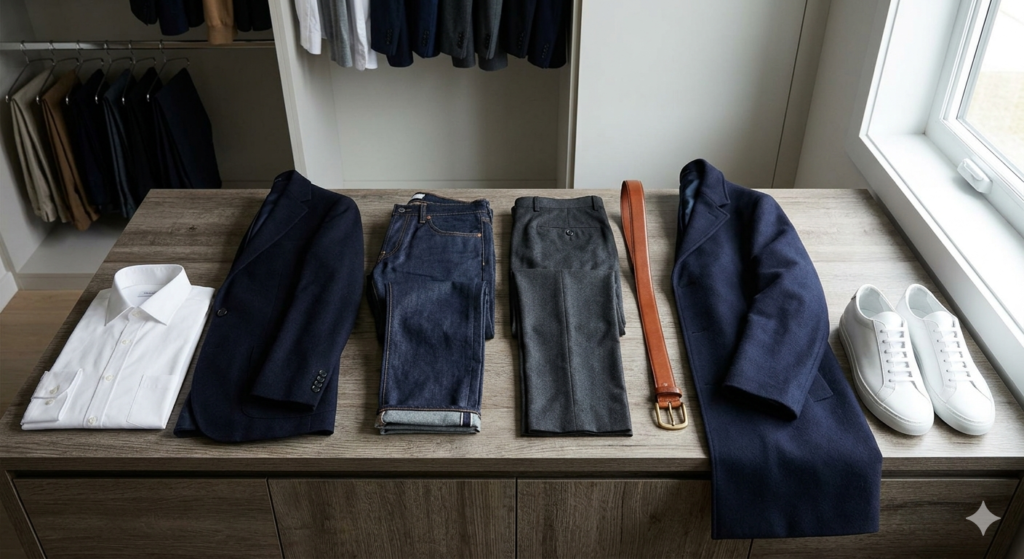
A white sneaker with tailored trousers reads as intentionally modern. With dark jeans, it reads as effortlessly casual. With a suit, it reads as confidently contemporary. No other shoe in history has achieved this versatility.
The Investment Calculation
A $400 white sneaker worn three times weekly for four years costs approximately $0.64 per wear. A $100 sneaker replaced annually costs $0.48 per wear—but delivers inferior comfort, construction, and aesthetic for those four years.
The premium isn’t luxury. It’s mathematics applied to quality.
The Rule
One pair. White leather. Minimal branding. Clean silhouette. Wear with everything.
The simplest shoe in your wardrobe might be the smartest investment you make.